रात बीत जाती है,
सहर…सवेरा भी होता है.
सूरज भी निकलता है,
पर मन में अँधेरा हीं होता है .
तभी छोटे से जलते चिराग़
का हौसला देखा.
जो रोशन जहांन को कर
अब सोने की तैयारी कर रहा था.

रात बीत जाती है,
सहर…सवेरा भी होता है.
सूरज भी निकलता है,
पर मन में अँधेरा हीं होता है .
तभी छोटे से जलते चिराग़
का हौसला देखा.
जो रोशन जहांन को कर
अब सोने की तैयारी कर रहा था.

अक्सर ख़ुद को समेटते समेटते
बिखर जाते हैं.
तट से टकराती सागर की
फेनिल लहरों की तरह.


Ageing can seem like a scary prospect, but a wealth of scientific studies have found that youth isn’t all it’s cracked up to be. There are plenty of cases in which human beings peak well into middle and old age.
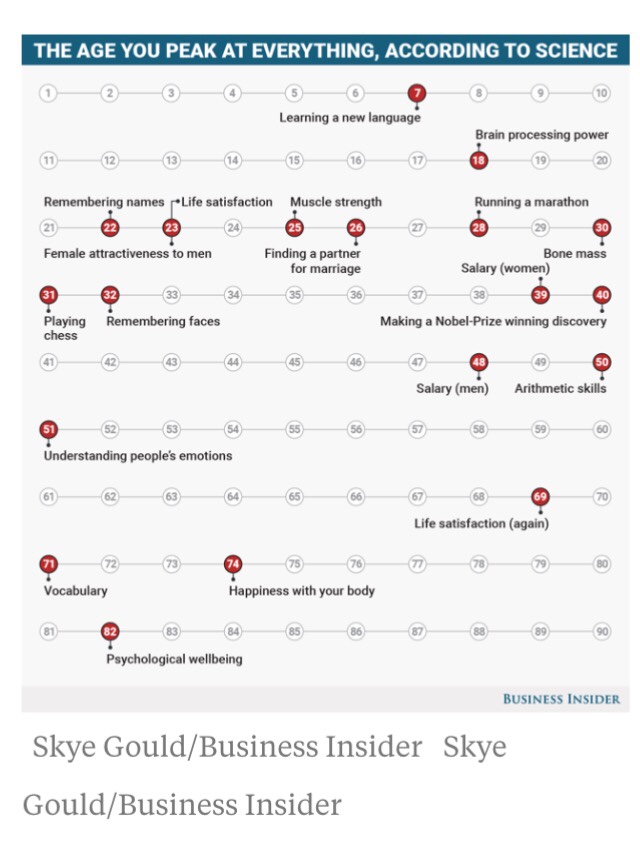
Teenagers, for instance, may have vitality on their side, but older people are generally more psychologically stable.
And so it goes with several phenomena people experience as they age.
Many of the points mark the middle of an age range that scientists have identified, which means they are all determined by averages.
Some are also surveys, not controlled trials, so there is a possibility the self-reports don’t capture the most accurate picture.
But in many cases, the numbers keep cropping up for a reason, which is that life isn’t a downhill slide from youth.
Here’s what you have to look forward to.
Learning a second language is easiest when you’re about 7 or 8.
Linguists and psychologists are still arguing about this one, but it’s commonly accepted that learning a second language is easier for most people when they’re younger, generally before puberty.
Brain processing power peaks at 18.
One of the key ways cognitive scientists test your brain’s processing power is through what’s called a digit symbol coding test – they equate a number with a certain symbol, then give you a string of numbers and ask you to convert them to the correct symbols.
On average, 18-year-olds fare best on the task, according to a studypublished in 2016.
The ability to remember unfamiliar names peaks at about 22.
We’ve all been there: you just met someone new, and their name went in one ear and out the other. It turns out that’s least likely to happen when you’re 22 or so, according to a 2010 study.
Women are most attractive to men at about 23. And men’s attractiveness to women seems to get better with age.
The cofounder of the online-dating site OKCupid wrote a book called Dataclysm that used data from his dating site to answer questions about love, dating, and relationships.
According to the book’s analysis of the data, men find women in their early 20s most attractive. Even as the men got older, their preference for 20-something women seemed to stay the same.
Women in their 20s on the site, on the other hand, tended to like slightly older men (a year or two older than they were) and women in their 30s tended to like men a few years younger than them.
A disclaimer: OKCupid’s data pool, which is based on its users, isn’t a representative sample of the population.
Life satisfaction first peaks at 23.
A survey of 23,000 people in Germany found that 23-year-olds were particularly satisfied with their lives, “all things considered”.
Strength peaks at age 25.
Your muscles are at their strongest when you’re 25, although for the next 10 or 15 years they stay almost as hefty – and this is one of the traits that can be most easily improved, thanks to resistance exercise.
The peak age to settle down is 26.
The 37 percent Rule of statistics says that at age 26 you’ll have met enough people to have some solid options without waiting so long that they start pairing off without you.
And according to one recent study, divorce rates are lowest for couples who married between the ages of 28 and 32.
The average elite marathoner is 28.
According to one 50-year analysis of marathons, the average age to complete the race in just over 2 hours was 28.
Bone mass peaks at about 30.
Your bones are at their strongest and densest when you’re 30 years old.
Again, you can keep your calcium and vitamin D intake high to keep your bones healthier longer, but eventually, they will start to weaken.
Chess players peak at about 31.
Scientists wanted to know whether physical and intellectual skills worked differently as people got older – so they studied chess grand masters.
By taking the scores of 96 grand masters over the course of their careers, the scientists were able to determine that on average, competitors do best at 31.
You’re best at learning new faces when you’re about 32.
People’s ability to quickly and accurately recognise faces of strangers being shown to them a second time in a lab test peaked at about 32. But nine years after your peak ability to remember names, you may need to ask them to reintroduce themselves anyway.
Nobel Prize winners make their big discovery at 40, on average.
According to a study by the US National Bureau of Economic Research, the average age when Nobel Prize-winning research is done is 40.
If you don’t think you’re in line to win a Nobel, the study authors say the concept still holds for other great achievements – people tend to do their most outstanding work in middle age.
Women’s salaries peak at about 39, and men’s at about 48.
Sure, your salary will hopefully keep rising to account for inflation, but will you actually be able to buy more with it as you age?
According to an analysis by Payscale, women earn the most when they’re 39, at a median of $60,000. That’s in part because women’s salaries start growing more slowly at about 30.
Men’s salaries peak when they’re about 48 or 49, at a median closer to $95,000.
Your understanding of other people’s emotions peaks in your 40s and 50s.
Scientists gathered about 10,000 people, showed them pictures cropped tightly around the subject’s eyes, and asked them to describe what emotion the person pictured was feeling.
They found a long plateau in people’s 40s and 50s when the ability to correctly identify emotions based only on the eyes was strongest.
Arithmetic skills peak at 50.
Sure, you learned your times tables in elementary school – but it turns out 50-year-olds are best at answering arithmetic questions on the fly.
Life satisfaction peaks again at 69.
Remember that study in Germany that found 23-year-olds were particularly satisfied with their lives? After a dip in middle age, life satisfaction peaked again at about 69 years old.
Even more intriguing, people over 60 had better life satisfaction than people 55 and up predicted they would feel five years down the line.
Vocabulary peaks in your late 60s or early 70s.
It turns out people’s scores on multiple-choice vocabulary tests keep climbing into their late 60s and early 70s.
And you don’t need to sit around reading the dictionary all day to make it happen – although it can’t hurt.
Men and women feel best about their bodies after 70.
In a Gallup survey, two-thirds of Americans over 65 said they always like the way they look.
Men’s self-perception appears to peak in their early 80s, when about 75 percent agree with the statement, “You always feel good about your physical appearance.”
Women’s rates of agreeing with that statement is a little below 70 percent when they hit about 74 years old.
People really do get wiser as they get older.
It turns out life really is the best classroom. A team of psychologists asked people to read about a conflict, then asked them questions about it.
The scientists analysed the responses for characteristics like being able to see from someone else’s point of view, anticipating change, considering multiple possible turnouts, acknowledging uncertainty, and searching for compromise.
They found that the oldest group they studied – people who were between 60 and 90 – did better than other ages on almost every count.
Psychological well-being peaks at about 82.
In a study published in the Proceedings of the National Academy of Science, scientists asked people to picture a 10-step ladder, with the best possible life on the top rung and the worst possible life on the bottom rung.
The oldest group they studied (82- to 85-year-olds) gave the highest average rung number, about 7.
People are most likely to make big decisions when their age ends in a 9.
There really is something daunting about approaching a round-numbered birthday. Researchers looking at people who were 29, 39, 49, or 59 found that they were more likely to make a big life change – good or bad.
They found that these “9-enders” were overrepresented in groups of people seeking to have an affair, people killing themselves, and people running a marathon for the first time.

“You have to keep breaking your heart until it opens.”
― Rumi
चुभते, बेलगाम, नुकीले आघातों से टूटना,
दस्तुर-ए- ज़िदंगी है।
पर किसी को तोङना क़सूर है।
दूसरों को तोड़ने की कोशिश
वही करते हैं, जो ख़ुद टूटे रहते हैं.
इसलिये हौसला हारे बिना
लगे रहना, आगाज-ए- जीत है।
कुछ पाने के लिए,
जंग लड़नी पड़ती है.
भाग्य भरोसे बैठने से अच्छा है
कोशिश करना .

कुछ लोगो में अजीब बचपना होता है. वे अपना वजूद….अस्तित्व…,पुरानी धरोहरों, इमारतों, दीवारों, पेड़ों पर और अब गैंडे के पीठ पर अपना नाम लिख कर क़ायम रखना चाहते हैं.

La Palmyre zoo in Royan in southwestern France said in a statement it was “outraged by the stupidity and disrespect” of the visitors but would not be taking legal action.
Animal lovers can touch the creatures when they approach the fence of their enclosure, it said, a “moving” experience which allows visitors to appreciate “the diversity and beauty of nature”.
News in detail France24.com
A Brahmin (Priest), whose profession was singing the glories of the Lord, was once reciting Srimad Bhagavatam in the house of a patron.
A thief broke into the house where the recital was going on and hid himself in the deep corner. Perforce, he had to listen to Srimad Bhagavatam (Beautiful stories & Miracles of Lord Krishna). The singer was now describing the ornaments worn by little Krishna. He described the various ornaments Mother Yasodha decorated on little Krishna before sending Him out with the cows. The thief was excited and thought that he should meet that lad and rob all the ornaments at one stroke instead of struggling every day with petty stealing. He waited till the entire chapter of Srimad was recited and left the place. The thief wanted to know where this boy was. He, therefore, followed the Brahmin and waylaid him. The Brahmin was frightened and feared that he would lose even the small amount he had received as dakshina and told the thief, “I do not have anything with me”.
The thief replied that he was not keen to have any of his possessions but wanted some information about that lad he claimed to have the best ornaments and who used to go out for grazing the cows. He beseeched him to take him to that place where the lad was grazing those cows.
The Brahmin was in a fix now. He said, “In the town of Brindavana, on the banks of Yamuna river, in a green meadow, two boys come every morning. One is dark like the clouds with a flute, and the other fair, clad in white silk. The dark one will have all the ornaments I had described.”
The thief believed the Brahmin and set out for Brindavana immediately. He located the beautiful place, climbed up a tree and waited for the boys to arrive. The sun rose. Faint melody of the flute wafted along the morning breeze. The enchanting music could then be heard closer and the thief spotted two boys coming. He got down from the tree and went near them. The moment he saw the most beautiful appearance of the little Krishna, he forgot himself, folded his hands and shed tears of joy. The tears were from his heart and it was chilling. He wondered which wretched mother had sent these radiant boys, chiseled to perfection, loaded with ornaments to the riverbank. He could not take his eyes off from the divinity. The transformation started. He approached the boys shouting, “Stop,” and held Krishna’s hand. The moment he touched Lord Krishna, all his previous karmas were wiped out like a ball of cotton getting burnt in fire and with all humility he inquired lovingly, “Who are you?”
Krishna looked at him, innocently and said, “I am frightened by your looks. Please leave my hands”. The thief, now full of remorse, said to Krishna, “It is my evil mind which is reflected in my face. If you are frightened, I shall go away. Please don’t say, I must leave you”.
The Natkhat (Divinely naughty) Krishna reminded the thief the purpose of his coming there and mocked him, “Here, take these ornaments”. Confused, the thief replied, “Will not your mother scold you if you gift away all your ornaments to me?”
Krishna with a smile said, “Do not worry about that. I have plenty of them. I am a bigger thief than you. But there is a difference between you and me – however much I steal, the owners do not complain. I am lovingly called “Chitta Chora”. Though you are not aware of it, you have a previous ornament in your possession, the “Chitta (Heart)”. I shall steal it now and take the same with Me”. So saying both the boys vanished. To his surprise, the thief found a bag full of ornaments on his shoulder. He brought it to the Brahmin’s house and told him what had all happened.

The Brahmin was now frightened and took the thief inside and opened the bag. To his utter amazement he saw all the ornaments described by him as being worn by Krishna in the Bhagavatam, in the thief’s bag. Shedding tears of joy, the Brahmin asked the thief to take him to the place where he saw the dark boy. The thief obliged and both of them waited in the same place where the thief accosted the boy the previous day. Suddenly the thief exclaimed, “Look, here they come!” However, the Brahmin could not see any one. Stricken with disappointment, he said, “Lord, when You decided to give darshan to a thief, why not me? Lord Krishna, out of abundant compassion, replied, “You are reading Srimad Bhagavatam just as another story, whereas the thief actually believed what you told him about me. I manifest only for those who have full faith in Me and surrender to what you told him about me. I manifest only for those who have full faith in Me and surrender to Me.”

Courtesy – Speakingtree
विष्णु के अष्टम अवतार,
देवकी के आठवें पुत्र,
अष्ट पत्नियाँ– रुक्मणि, जाम्बवन्ती, सत्यभामा,
कालिन्दी, मित्रबिन्दा, सत्या, भद्रा और लक्ष्मण को
राधा को, मीरा को, गोपियों को,
कान्हा क्यों सभी को अच्छे लगते हैं ?
मुरली प्यारी है या मोर मुकुट? या स्वंय केशव?
कोई नहीं जान पाया…..
बस इतना हीं काफी है – वे अच्छे लगतें हैं।

 The REKHA SAHAY Corner!
You must be logged in to post a comment.