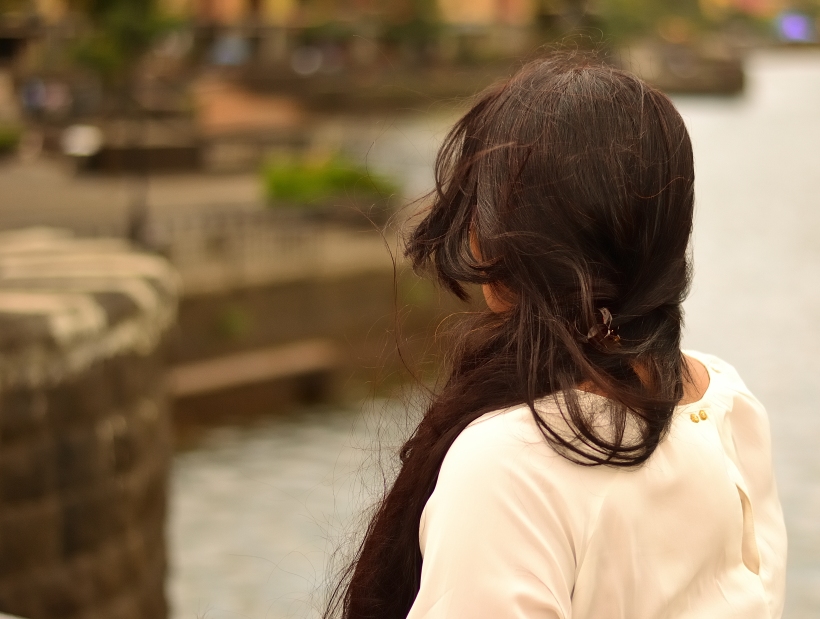
ज़िंदगी के रंग- 89

एक टुकड़ा ज़िंदगी का

बानगी है पूरे जीवन के

जद्दोजहद का .

उठते – गिरते, हँसते-रोते

कभी पूरी , कभी स्लाइसों

में कटी ज़िंदगी

जीते हुए कट हीं जाती है .

इसलिए मन की बातें

और अरमानों के

पल भी जी लेने चाहिये.

ताकि अफ़सोस ना रहे

अधूरे हसरतों ….तमन्नाओं …. की.

Pattern

In silence there

is eloquence.

Stop weaving

and see how

the pattern

improves.

Rumi ❤️❤️

Child friendly courts: HC urges state government, India

In February 2018, The Supreme Court directed that “child friendly and vulnerable witness courts” be set up in every district.

These special courts try offenses under the protection of children from sexual offences act, juvenile Justice act, prohibition of marriage act and sexual offences against minors under the Indian penal code.

Such courts have already been set up in Delhi, Hyderabad, Bengaluru and Kolkata.

The court in Bengaluru has two rooms separated by a one-way glass shield, there is video conferencing facility for children who refuse to testify in court.

The model “child witness courtroom” in Delhi also has a play area and a pantry.

Source:

The times of India, Mumbai, Thursday, August 16, 2018, pg-5.

Poor sleep triggers viral loneliness and social rejection

Poor sleep can literally kill your social life.

UC Berkeley researchers have found that sleep-deprived people feel lonelier and less inclined to engage with others, avoiding close contact in much the same way as people with social anxiety.

Worse still, that alienating vibe makes sleep-deprived individuals more socially unattractive to others. Moreover, even well-rested people feel lonely after just a brief encounter with a sleep-deprived person, triggering a viral contagion of social isolation.

The findings, published today in the journal Nature Communications, are the first to show a two-way relationship between sleep loss and becoming socially isolated, shedding new light on a global loneliness epidemic.

“We humans are a social species. Yet sleep deprivation can turn us into social lepers,” said study senior author Matthew Walker, a UC Berkeley professor of psychology and neuroscience.

Notably, researchers found that brain scans of sleep-deprived people as they viewed video clips of strangers walking toward them showed powerful social repulsion activity in neural networks that are typically activated when humans feel their personal space is being invaded. Sleep loss also blunted activity in brain regions that normally encourage social engagement.

Courtesy:

1.http://news.berkeley.edu/2018/08/14/sleep-viral-loneliness/

2. Mumbai mirror.

Promise, friendship and relationship

Always take care of

these three things in life –

promise,

friendship and

relationship

because they don’t

make noise,

but when they break

they create silence.

Kabir : The songs of a weaver – 1

Listen carefully,

neither the vedas

nor the Quran

will teach you this:

put the bit in its mouth,

The saddle on its back,

your foot in the stirrup,

And ride your wild runway mind,

all the way to heaven.

Meaning –

Self – rider

chariot – the body

The intellect – charioteer,

Our mind – reins

The senses – horse,

The parts around them are the objects of the senses.

Translated by : Vinay Dharwadker

India: What is the difference between the flag ceremony on 15th Aug and 26th Jan?

Some interesting facts:

1. On 15th Aug the flag is HOISTED (from below) and unfurled. Reflecting the very first day in 1947 when it was done so for the first time.

On 26th Jan, the flag is already up there and is UNFURLED

Even the ceremonies are called flag hoisting and unfurling the FLAG.

2. PM will be hoisting the flag on Independence day and President will be hoisting the flag on republic day .

( second point, courtesy: blogger friend Prasath )

As forwarded

ज़िंदगी के रंग – 88

ज़िंदगी के दो छोरों

को बाँधने की कोशिश

ना करना.

हमने इस कोशिश में

जाया किया है

सुनहरे पलों को.

और हाथ आया सिफ़र .

यह तो वह बहाव है .

जो अपना रास्ता

ख़ुद ही ढूँढ लेती है .

The India I dream of  


On the 15th day of August 1947, India commenced its long march to overcome the colonial legacy of poverty, illiteracy, social inequality and underdevelopment. Since then the task of nation building process has been taken up by our people with firm determination and certain elan to succeed. Our first prime minister’s famous ‘tryst with destiny’ speech on the eve of independence reflected the buoyant mood of the nation. There was a sense of fulfilment in the air and confidence in our future destiny.

However, our 71 year long journey as a nation has seen its own share of challenges. From the beginning many critics and admirers have expressed doubts about India’s ability to sustain it’s developmental design. They have repeatedly argued that the vast disparity would lead to disintegration of the country into linguistic and ethnic fragments. Although India has survived the test of time, every instance of social unrest and political turmoil such as secessionist movements in different parts of the country, naxalite uprising, cast or communal violence pose a serious threat to India’s multi cultural social framework.

The India I dream of is a state where people feel a sense of national integration not because of similar ethnicity or long lasting cultural history but because of a shared set of ideals. I believe that our objective of development as a nation and a democratic polity must lay the foundation of our national identity. I believe that true Indianness aims at integration but does not believe in assimilation of the various diverse groups into the national mainstream. Indianness acknowledges and accommodates multiple identities of the people of India and gives different parts of the country adequate space in the Indian union and at the same time it believes in nurturing and preserving ones own cultural or linguistic identity. I believe that it is important for us to be able to look beyond the frames imposed on us by our religious and cultural beliefs. It must be understood that our diversity is our strength, it enriches our culture, but our differences lead to parochialism hindering our growth as one nation.

Further, I believe that governance is conceptualised as a social contract in which the people and the government have mutually reinforcing roles. According to me, many of the social challenges faced by people in india arise from the breakdown of this social contract by one or both of us by not living upto our responsibilities. The present Indian society is struggling to fight numerous social evils such as gender disparity, casteism, corruption and numerous social stigmas. I believe that social transformation is the need of the hour. This can be done by building our nation as an instrument of development and social change. As Justice Louis Brandies, once said, “ The most important political office is that of a private citizen”. In order to efficiently exercise the rights and duties of a responsible citizen, it is important to spread knowledge and awareness among the citizens of india. With firm belief in what Mahatma Gandhi said, “Education not only moulds the new generation, but reflects a society’s fundamental assumptions about itself and the individuals which compose it”, I believe that the first step towards making a robust country is building an imaginative and skilful educational setup guided by hard-nosed national interest and tempered with morality and ethics. Furthermore, demographically speaking, India is a young country and it is estimated that approximately 50% of India’s population is in the age group of 15-25 years. I see this as an opportunity where India can fulfil her aspiration of being a world power as an ageing world population will soon need a younger workforce. India can utilise this situation for its economic growth through strategic intervention in education and skill development.

Also, I believe, that we should draw our inspirations and lessons from our past. Yoga, an ancient art form which originated in India, is a practice for balancing the connection between mind, body and soul is being used across nations for physical, spiritual and mental upliftment. According to me, this science must be utilised to the fullest by every individual in the country.

Lastly, I envision India as an egalitarian state where different sections of the society have equal rights and opportunities. It should be a person’s choice and ability that must determine the course of his or her life. Meritocracy and healthy competition must lay the foundation of Indian society.

By,

Chandni Sahay,

Naag panchami , 15 August 2018: worship of snakes

Naga Panchami (Sanskrit: नाग पंचमी) is a traditional worship of snakes or serpents observed by Hindus throughout India, Nepal and other countries where Hindu adherents live.

Nag Panchami is celebrated on the Shukla Paksha Panchami during Shravan month. The day falls on the fifth day of the moon’s waning in the Lunar Hindu month of Shravan / monsoon – July /August.

Agricultural significance
Shravan / monsoon is the best time for cultivation in India. As fields are the dwelling ground for snakes, Nag Panchami is celebrated to calm them, so that they don’t bite them during cultivation.

The harmony and bond between human and nature

Farmers celebrate the day by not digging the fields and by worshiping snake idols made of mud.

Legends and mythology-

Lord Krishna and Kalia –

A deadly snake Kalia had been poisoning the river Yamuna and it had become difficult for the residents of Braj to drink any water. Krishna, as a child Avatar of Lord Vishnu, one day on the pretext of a ball falling down in the river has a tussle with Kalia and eventually defeats him.

Snake and Lord Shiva

A snake also adorns the neck of Lord Shiva and has a lot of spiritual significance too. The three coils around Shiva is also the indication of the past, present and the future. It also signifies that the Shakti / kundalini energy finally dances around Shiva, while Shiva the omnipresent is static.

Samudra Manthan–

Lord Shiva drank all the poison that came out from the churning of the sea. However, in the whole process few drops did fell on the ground and were drunk by snakes. People pray to snakes so that they and their families are spared of their wrath and poisonous bites.

Source:

1. https://en.m.wikipedia.org/wiki/Naga_Panchami

2. https://www.google.co.in/amp/s/www.astrospeak.com/slides/why-do-we-celebrate-nag-panchami/m-lite