Floating ‘raft’ of pumice rock the size of Birmingham spotted in Pacific अद्भुत नजारा -150 वर्ग किलोमीटर से अधिक बड़े तैरते प्युमिक पत्थर

रामायण में वर्णित लकां तक पहुँचने के तैरते पुल की याद दिला रहा है, प्रशांत महासागर में तैरते विशालकाय प्युमिक चट्टानों का अद्भुत नजारा।

Rate this:

प्रशांत महासागर में बर्मिंघम के आकार के प्युमिक रॉक देखा गया है। यह 150 वर्ग किलोमीटर से अधिक बड़ी है। यह एक पानी के नीचे ज्वालामुखी के कारण बना है, जो टोंगा के पास फट गई थी।

विशेषज्ञों का मानना ​​है कि ये चट्टानें जिनमें से कुछ बास्केटबॉल के आकार की हैं,सात से 10 महीनों में ऑस्ट्रेलियाई तट तक पहुंच जाएंगी, जहां वे नष्ट हो रहे ग्रेट बैरियर रीफ को फिर से भर सकते हैं।
Although the pumice (pictured from space) is currently bare, organisms such as crabs and corals, will start growing on it in the coming weeks: NASA


A ‘raft’ of pumice rock the size of Birmingham has been spotted in the Pacific ocean. The floating sheet is more than 150 square kilometres large and was caused by an underwater volcano which erupted near Tonga. 

Experts believe that the rocks – some of which are the size of basketballs – will reach the Australian coast in seven to 10 months where they could replenish the Great Barrier Reef, which is being destroyed by coral bleaching. Michael and Larissa Hoult, who are crew of the Australian adventure catamaran ROAM, found themselves sailing through the mass of rocks earlier this month while on their way to Fiji.


News in detail

Organic Food’s Health Benefits Have Been Hard To Assess. But That Could Change

Experts in academia, providing fact-based analysis of issues for the public

By Cynthia Curl

Organic” is more than just a passing fad. Organic food sales totaled a record US$45.2 billion in 2017, making it one of the fastest-growing segments of American agriculture. While a small number of studies have shown associations between organic food consumption and decreased incidence of disease, no studies to date have been designed to answer the question of whether organic food consumption causes an improvement in health

I’m an environmental health scientist who has spent over 20 years studying pesticide exposures in human populations. Last month, my research group published a small study that I believe suggests a path forward to answering the question of whether eating organic food actually improves health.

What we don’t know

According to the USDA, the organic label does not imply anything about health. In 2015, Miles McEvoy, then chief of the National Organic Program for USDA, refused to speculate about any health benefits of organic food, saying the question wasn’t “relevant” to the National Organic Program. Instead, the USDA’s definition of organic is intended to indicate production methods that “foster cycling of resources, promote ecological balance, and conserve biodiversity.”

While some organic consumers may base their purchasing decisions on factors like resource cycling and biodiversity, most report choosing organic because they think it’s healthier.

Sixteen years ago, I was part of the first study to look at the potential for an organic diet to reduce pesticide exposure. This study focused on a group of pesticides called organophosphates, which have consistently been associated with negative effects on children’s brain development. We found that children who ate conventional diets had nine times higher exposure to these pesticides than children who ate organic diets.

Our study got a lot of attention. But while our results were novel, they didn’t answer the big question. As I told The New York Times in 2003, “People want to know, what does this really mean in terms of the safety of my kid? But we don’t know. Nobody does.” Maybe not my most elegant quote, but it was true then, and it’s still true now.

Studies only hint at potential health benefits

Still, scientists can’t directly translate these lower exposures to meaningful conclusions about health. The dose makes the poison, and organic diet intervention studies to date have not looked at health outcomes. The same is true for the other purported benefits of organic food. Organic milk has higher levels of healthy omega fatty acids and organic crops have higher antioxidant activity than conventional crops. But are these differences substantial enough to meaningfully impact health? We don’t know. Nobody does.

Since 2003, several researchers have looked at whether a short-term switch from a conventional to an organic diet affects pes

Since 2003, several researchers have looked at whether a short-term switch from a conventional to an organic diet affects pesticide exposure. These studies have lasted one to two weeks and have repeatedly shown that “going organic” can quickly lead to dramatic reductions in exposure to several different classes of pesticides. 

Some epidemiologic research has been directed at this question. Epidemiology is the study of the causes of health and disease in human populations, as opposed to in specific people. Most epidemiologic studies are observational, meaning that researchers look at a group of people with a certain characteristic or behavior, and compare their health to that of a group without that characteristic or behavior. In the case of organic food, that means comparing the health of people who choose to eat organic to those who do not.

Several observational studies have shown that people who eat organic food are healthier than those who eat conventional diets. A recent French study followed 70,000 adults for five years and found that those who frequently ate organic developed 25% fewer cancers than those who never ate organic. Other observational studies have shown organic food consumption to be associated with lower risk of diabetes, metabolic syndrome, pre-eclampsia and genital birth defects.

Spiritual Poets Tulsidas & Rahim – a weaver & a worrier

Tulsidas came to know about a unique behaviour of Rahim. While giving alms to the poor, Rahim gave with extreme humility. While giving, he kept his gaze downwards towards the earth.  He never looked at the person he was giving alms to. Tulsidas promptly wrote the following couplet and sent it to Rahim.

“ऐसी देनी देंनज्यूँ, कित सीखे हो सैन 

जयोंज्यों कर ऊंच्यो करो, त्योंत्यों निचे नैन” 

Meaning – “O great person, where have you learnt this amazing way of giving? As your hands rise (to give), your eyes look down”
Completing the couplet which Tulsidas wrote, Rahim replied in extreme humility. 

His reply shows how evolved Rahim was as a soul.

“देनहार कोई और है, भेजत जो दिन रैन

 लोग भरम हम पर करे, तासो निचे नैन”


Meaning- “The Giver is someone else (the God almighty), giving day and night.
The world has a misconception that I am the giver. So, I lower my eyes in embarrassment.”

Tulsidas 1532–1623, also known as Goswami Tulsidas, was a HinduVaishnava saint and poet, renowned for his devotion to the deity Rama. Tulsidas wrote several popular works in Sanskrit and Awadhi; he is best known as the author of the epic Ramcharitmanas, a retelling of the SanskritRamayana based on Rama‘s life in the vernacular Awadhi dialect of Hindi.

KhanzadaMirzaKhanAbdul Rahim Khan-e-Khana (17 December 1556 – 1627) also known as Rahim was a poet who lived during the rule of Mughal emperor Akbar. He was one of the nine important ministers (dewan) in his court, also known as the Navaratnas. Rahim is known for his Hindi dohe (couplets) and his books on astrology. The village of Khan Khana, which is named after him, is located in the Nawanshahr district of the state of Punjab, India

Write up shared by – Manish Khare

Writer – Anonymous

Informations about Tulsidas & Rahim courtesy – Wikipedia.

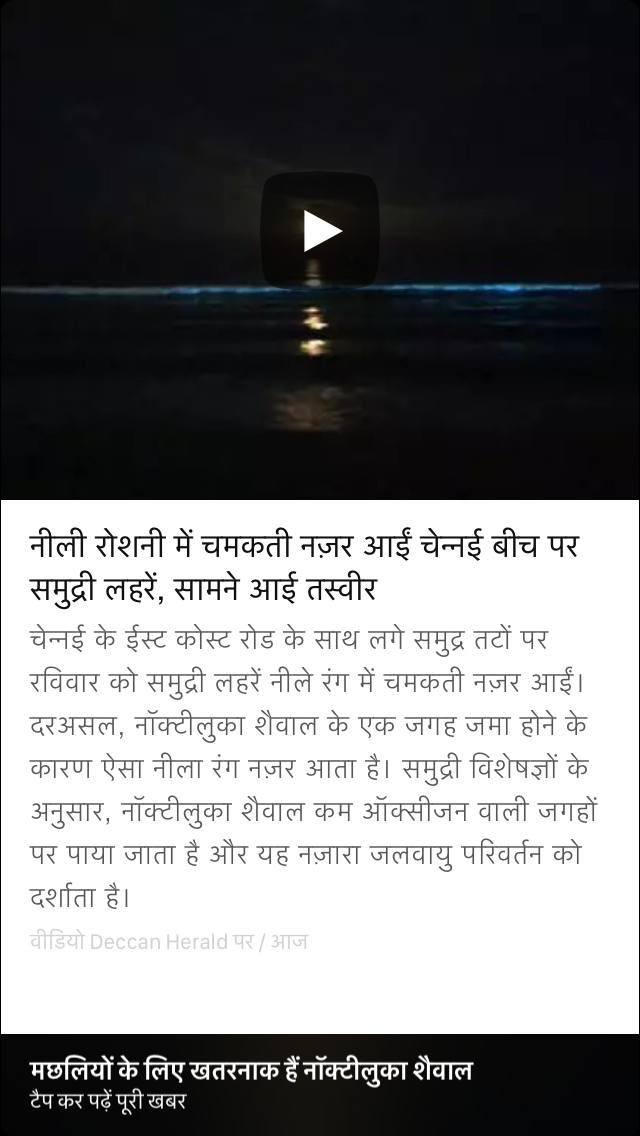
Sea Sparkles Seen At Chennai Beaches, But It May Not Be Good News

Video-

youtu.be/jyI4Iy4qA_Q

The phenomenon was very rare. The ‘magical glow’ is caused by a high concentration of a micro-plankton called Noctiluca scintillans in the sea.

While the sparkle is similar to the fireflies’ glow, the micro-plankton itself cannot be seen by the naked eye as it’s a micro-organism.

https://www.thequint.com/news/environment/rare-sea-sparkles-seen-at-chennai-beaches?utm_campaign=fullarticle&utm_medium=referral&utm_source=inshorts

ANI journalist stands up against Pakistanis’ despicable act to disregard Indian flag

Video twitter.com/ANI/status/1162761389829763072

Rate this:

Video twitter.com/ANI/status/1162761389829763072

इतनी नफ़रत क्यों?

और नफ़रत दिखाने का

इतना बेकार तरीक़ा क्यों?

बेहद दुखद घटना .

The demonstrators, backed and encouraged by the Government of Pakistan to amass and protest outside the Indian High Commission, had gathered on 15 August which marked the day of India’s Independence. Pakistan had celebrated the occasion as a ‘Black Day’ in an attempt to internationalise the recent developments in the Indian territory of Jammu and Kashmir.

https://www.google.co.in/amp/s/wap.business-standard.com/article-amp/news-ani/ani-journalist-stands-up-against-pakistanis-despicable-act-to-disregard-indian-flag-119081700990_1.html

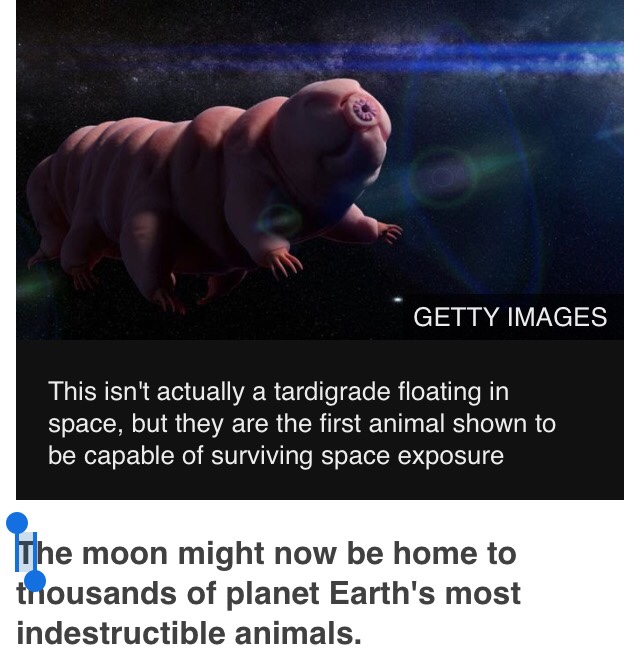
क्या आप जानते हैं टार्डिग्रेड्स या वाटर बीयर क्या है ?

चंद्रमा अब पृथ्वी के सबसे अविनाश, हजारों टार्डिग्रेड्स या वाटर बीयर जीवों के घर हो सकता है।

Rate this:

इजरायल द्वारा संचालित  अंतरिक्ष यान चांद पर जाना था। इसके पेलोड में आर्क मिशन फाउंडेशन द्वारा बनाई गई एक डीवीडी-आकार की लाइब्रेरी शामिल थी, जिसमें सूचनाओं के विशाल समूह और हजारों निर्जलित टार्डिग्रेड् थे।
बेर्सेट अंतरिक्ष यान फरवरी में लॉन्च हुआ और अप्रैल में चंद्रमा पर उतरने में विफल रहा।अप्रैल में इस  लैंडर की चंद्रमा पर दुर्घटना हो  गई और सम्भावना व्यक्त किया जा है कि वाटर बीयर चाँद पर बच गए है. 
वाटर बीयर लगभग अविनाशी या जल्दी ना मरने वाले जीवों की एक छोटी प्रजाति है. माना जा रहा है कि, शायद वाटर बीयर ने हम से पहले चंद्रमा पर कब्जा कर लिया है. चंद्रमा अब पृथ्वी के सबसे अविनाशी हजारों जीवोंग्रह का घर हो सकता है।
टार्डिग्रेड्स - एक मिलीमीटर से कम लंबे जीव होते हैं जो 150C तक गर्म और लगभग पूर्ण शून्य तक जमे हुए जीवित रह सकते हैं।इज़राइली अंतरिक्ष यान सह-संस्थापक के अनुसार टार्डिग्रेड्स निश्चित रूप से अभी भी जीवित हैं। हम मानते हैं कि टार्डिग्रेड्स के लिए जीवित रहने की संभावना बहुत अधिक है"आर्क मिशन फाउंडेशन के बॉस नोवा स्पिवैक ने भी कहा।

When it comes to putting out messages, China does a better job than India

Is ancient India overrated ?  A mindblowing analysis by Chinese Ex Professor from University of Toronto   Author: Pak L. Huide

Rate this:

Publication: Postcard.news  Date: July 22, 2017 URL: http://postcard.news/is-ancient-india-overrated-a-mind blowing-analysis-by-chinese-professor-from-university-of-toronto/

Seriously? If anything, ancient India is sorely UNDERRATED. I mean, I’m an ethnic Chinese living in Canada. But when I was growing up in Canada, I knew jackshit about India. Besides maybe curry. I mean, people here have a vague understanding of Chinese history but they have NO idea about Indian history. For example, most people know that the Middle Kingdom is how China referred to herself but how many people know about Bharat? How many know about even the Guptas? People know that China was famous for ceramics and tea but how many people know about ancient India’s achievements in metallurgy? People know about the Great Wall, but how many know about the great temples of southern India?

This is partly due to the lackluster historical records that ancient Indians kept and also partly because modern Indians have a tendency to look down upon their ancient heritage and view western ideas and ideals as superior. China also has this problem but not nearly to the same extent.

The discovery that the earth is spherical is credited to the Greek philosopher Aristotle, who was born in 384 BCE. However, very few people know that a man from ancient India established the idea of “spherical earth” during the 8th-9th century BCE. The man was called Yajnavalkya who first discovered that the earth is round. He was the first to propose the heliocentric system of the planets. In his work Shatapatha Brahmana, he proposed that the earth and the other planets move around the sun. He also calculated the period of one year as 365.24675 days. This is only 6 minutes longer than the current established time of 365.24220 days.

Take the example of Kung Fu. The whole world knows about the martial art called Kung Fu. The person who founded Kung Fu was none other than a prince of the Pallava dynasty from Kanchipuram, Tamil Nadu who visited China during the 5th century CE. He became the 28th patriarch of Buddhism and established the Shaolin temple and founded the martial art which became world famous today. That prince was called Bodhidharma.

But how many people know about that Kung Fu and Shaolin was founded by an Indian?Precisely, if Indians are unaware of their heritage, why should they expect that someone else will know about their history and achievement?

The achievements of ancient Indians are lost in obscurity. India’s ancestors had invented many ways which eased the basic life of a common man. These inventions may seem primitive today, but we can’t ignore the fact that these were revolutionary achievements during their era.The Indus Valley civilization is known for the broad and the sanitized drainage system which was no less than a miracle during those ancient times. But how many people know that the ancient Indians from Indus Valley Civilization (IVC) were the first to invent a flush toilet?

The people around the world use rulers to measure everything. How many people know that Indus Valley Civilization was the first to invent the rulers? A ruler has been found at Lothal which is 4400 years old. Not only this, the people of IVC were the first to invent buttons. The world knows that the Chinese discovered the art of weaving silk dresses. How many people know that IVC people were the first to weave dresses made of cottons?

The ancient Indians were first to invent the weighing scales. Archaeologists have discovered weighs and scales from the excavation sites of Harappa, Mohenjodaro, Lothal etc. These scales were extensively used for trading. Ancient India has given Yoga to the world- which is widely practiced almost all over the world to keep people fit and fine. Models, supermodels, film stars, athletes, etc. regularly attends Yoga session to keep themselves fit.

Aryabhatta, Brahmagupta and Bhaskaracharya were the three eminent mathematicians from ancient India who established the concept of zero as a mathematical value in different eras. Brahmagupta was the first to invent a symbol for the value “shunya” (zero). Bhaskaracharya was the first to use it as algebra. The oldest inscription of zero can be found at the Chaturbhuj temple in Gwalior fort.

Ancient Indians were pioneers in the field of chemistry too. The person who first invented the “atomic theory” was none other than Acharya Kanad from ancient India. He explained the atomic theory using terms like “Anu”(atom) and “Paramanu”(nucleus).

Ancient Indians were advanced in medical science too. The great physician of the time, Sage Shusrut was the first to carry out different surgeries which included plastic surgery and cataract surgery. His works are composed in his book called Shusrut Samhita (The works of Shusrut). The world hardly knows about Charak, the great specialist in medicine from ancient India. He was the first physician to establish the problems and medicinal treaties in fields like physiology, embryology, digestion, sexual disease, immunity, etc. His works on Ayurveda is composed as a book called Charak Samhita (The works of Charak).

The Chera dynasty of Tamil Nadu invented the idea of producing finest steel by heating black magnetite ore along with carbon. The mixture was kept in a crucible and heated in charcoal furnace. The Wootz Steel originated from India, but today, is popular as Damascus Steel. India’s monuments are grand and are probably, the only way others recognize the importance of ancient Indian civilization. India’s gigantic monuments bear the testimony of the greatness of ancient India.

This is the Kailash Temple. It is a megalith which was constructed by cutting out a single rock- a mountain. The whole mountain was cut from the top to carve out the temple campus.This is Dwarka, the grand and mysterious city submerged in the Arabian sea on the extreme west of India. The submerged heritage is no less than a treasure bearing the pride of Indian race!

This is Khajuraho, the marvel where the rocks has taken the form. The best of our monuments are not built on soft rocks like marble. Our ancestors carved out even the hardest of the rocks to give it a beauty. The grandest and largest temple in India- Brihadeshwara temple. Breathtaking, isn’t it?India is the land of grandest temples and breathtaking architectures. The heritage of India can’t be encapsulated within a small answer! To end the answer with, I will now share my personal favourite- The Sun Temple of Konark! The main structure of the temple was partially destroyed by invaders like Kalapahad- a military general of the medieval period. Later, the prime structure totally collapsed when British stored gunpowder inside the structure and it caught fire accidentally.

Even though the main temple is gone, the amount of what left is still breathtaking by every means. Nobel Laureate Rabindranath Tagore wrote about Konark-  “here the language of stone surpasses the language of man.” The whole temple was designed like a huge chariot of Sun God having 24 wheels pulled by 7 horses. Each wheel had 8 major spokes denoting 1 prahar (Hindu time period of 3 hours). There was a huge magnet at the top of the temple which used to keep the idol of the Sun deity suspended in the air due to magnetic arrangement.

Still think, that ancient India is overrated?

Ancient India was a hub of culture and technology and the absolute capital of world spirituality. I could talk about India for hours. India is many things but OVERRATED is definitely not one of them.

Courtesy- https://postcard.news/is-ancient-india-overrated-a-mindblowing-analysis-by-chinese-professor-from-university-of-toronto/


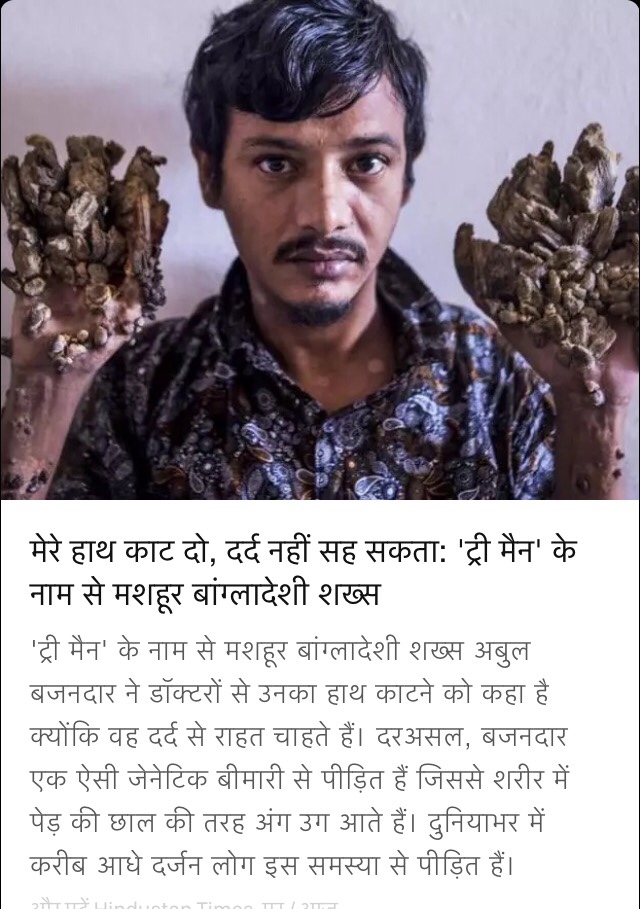
Treeman syndrome, Epidermodysplasia verruciformis (EV)

Epidermodysplasia verruciformis (EV), also known as treeman syndrome, is an extremely rareautosomal recessive hereditary skin disorder associated with a high risk of skin cancer. It is characterized by abnormal susceptibility to human papillomaviruses (HPVs) of the skin. The resulting uncontrolled HPV infections result in the growth of scaly macules and papules resembling tree bark, particularly on the hands and feet. It is typically associated with HPV types 5 and 8, which are found in about 80% of the normal population as asymptomatic infections, although other types may also contribute.


Courtesy- wikipedia

प्लेसीबो इफेक्ट

अपने मन का खुद इलाज संभव है, बस सकारात्मक सोच की जरुरत है।

Rate this:

प्लेसीबो इफेक्ट ऐसी चिकित्सा को कहते हैं जिसका कोई वैज्ञानिक आधार नही है। ऐसी चिकित्सा पद्धति या तो प्रभावहीन होती है, या काफी सुधार दिखता है। उसका कारण साकारात्मा मानसिक स्थिति होती है। प्लेसीबो के उपयोग से अक्सर लाभ होता दिखता है। जिसे प्लेसीबो इफेक्ट या प्लेसीबो रिस्पॉन्स कहते हैं। प्लेसीबो इफेक्ट के पीछे कई अन्य साकारात्मा मानसिक ‘प्रभाव’ होते हैं जो लाभ पैदा करते हैं। इस विषय पर अनेकों मनोवैज्ञानिक शोध चल रहें है।

इसे एक नकली उपचार भी कह सकते हैं। एक निष्क्रिय पदार्थ जैसे कि चीनी या जल दवा के तौर पर देने पर कभी-कभी, कुछ हालातों में रोगी की स्थिति में सुधार होती हैं क्योंकि व्यक्ति को यह उम्मीद होती है कि यह असल दवा है जो मददगार होगी। पर यह हर हालात में काम नहीं करती। कुछ स्थितियों में प्लेसीबो प्रभाव एक शक्तिशाली तरीका साबित हो रहा है।। एक व्यक्ति जितना अधिक विश्वास करता है कि वे एक उपचार से लाभान्वित होने जा रहे हैं, उतनी अधिक संभावना है कि वे लाभ का अनुभव करेंगे।


What is Placebo Effect

Treating yourself with your mind is possible, but there is more to it than positive thinking.

Rate this:

Placebo effect: Also called the placebo response. A remarkable phenomenon in which a placebo — a fake treatment, an inactive substance like sugar, distilled water, or saline solution — can sometimes improve a patient’s condition simply because the person has the expectation that it will be helpful. Expectation to plays a potent role in the placebo effect. The more a person believes they are going to benefit from a treatment, the more likely it is that they will experience a benefit.

To separate out this power of positive thinking and some other variables from a drug’s true medical benefits, companies seeking governmental approval of a new treatment often use placebo-controlled drug studies. If patients on the new drug fare significantly better than those taking placebo, the study helps support the conclusion that the medicine is effective. The power of positive thinking is not a new subject.Research is ongoing as to why some people experience changes even when they are only receiving a placebo.


courtesy- https://www.medicinenet.com/script/main/art.asp?articlekey=31481